The Silent Mathematics of Dice Balancing in Underground Asian Gaming Circuits
Drew Butler · Jun 28, 2026

The Silent Mathematics of Dice Balancing in Underground Asian Gaming Circuits
Underground gaming circuits across parts of Asia maintain strict protocols for dice integrity where even minor deviations in weight distribution alter expected outcomes in ways that compound over thousands of rolls. Observers note that operators rely on mathematical verification rather than visual inspection alone because center-of-mass shifts as small as 0.2 millimeters can skew probabilities measurably. Research indicates these circuits often source dice from specialized manufacturers that apply the same calibration standards found in regulated environments yet operate without formal oversight. Data from regional enforcement records shows repeated instances where imbalanced dice led to disputes resolved through statistical re-testing of historical rolls rather than immediate confrontation.
Core Principles of Dice Equilibrium
Each die must distribute mass uniformly across its six faces so that the probability of any single outcome remains exactly one in six over large sample sizes. Engineers achieve this by drilling pips to identical depths then filling them with material matching the cube's density before final polishing. Studies from probability researchers demonstrate that even slight variations in pip volume shift the center of gravity enough to favor certain faces after repeated trials. In underground settings participants apply floating tests in calibrated saline solutions where a balanced die settles without tilting toward heavier sides. Those conducting these checks record results across multiple orientations to confirm consistency before accepting the set for play.
Statistical Verification Methods
Operators frequently employ chi-square goodness-of-fit tests on recorded roll sequences to detect departures from uniform distribution. A sample of five hundred rolls provides sufficient power to identify imbalances at the 95 percent confidence level when frequencies deviate beyond expected thresholds. Technicians compare observed counts against theoretical values of approximately 83.3 occurrences per face then calculate p-values that determine whether the dice warrant replacement. One documented case involved a private salon in Southeast Asia where sequential data revealed a persistent over-representation of sixes prompting immediate statistical review and subsequent discard of the set.
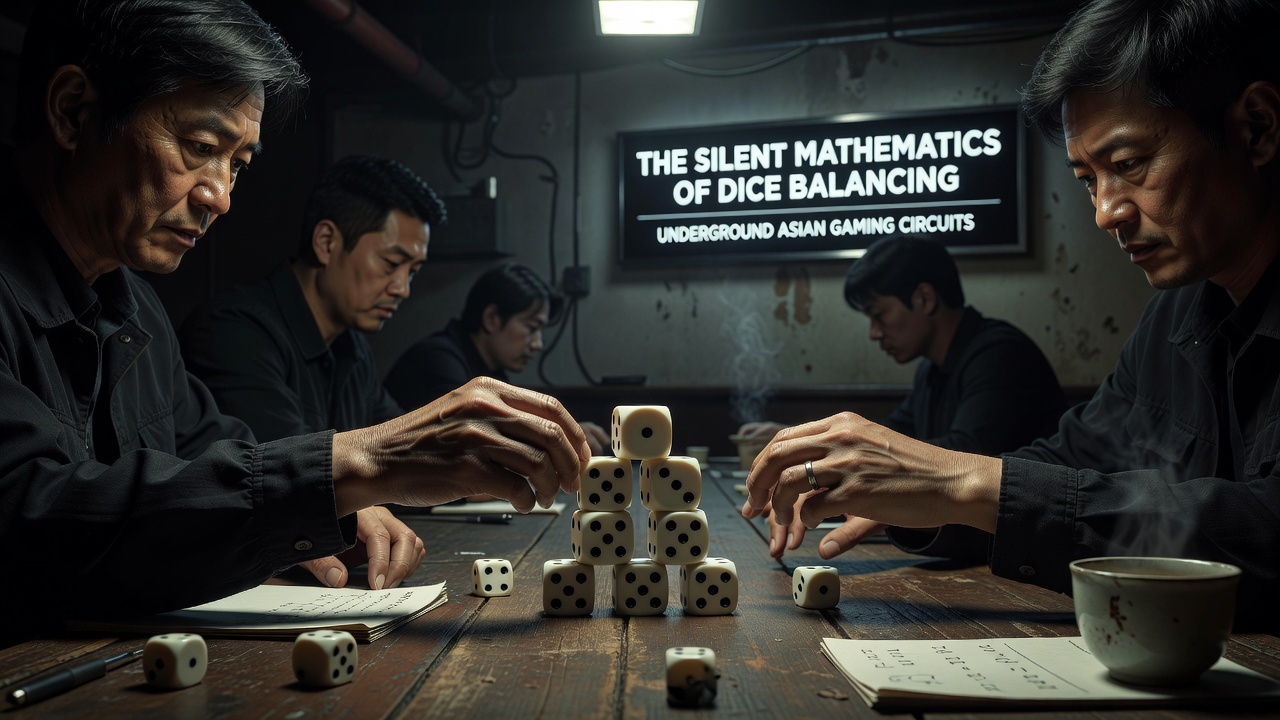
Additional layers include moment-of-inertia calculations derived from spin-duration measurements because balanced cubes maintain consistent rotation times across axes. Devices that time multiple spins allow rapid screening without full statistical accumulation. Figures released in June 2026 by independent testing laboratories in the region highlighted how portable spin analyzers reduced verification time by 40 percent while maintaining detection accuracy comparable to laboratory equipment.
Material Science and Manufacturing Tolerances
High-grade cellulose acetate and polymer composites dominate production because these materials resist moisture absorption that could otherwise alter weight distribution during extended sessions. Manufacturers machine each cube to tolerances under 0.05 millimeters then verify flatness on optical comparators before numbering. According to specifications outlined by the Casino Regulatory Authority of Singapore such precision minimizes edge effects that accumulate in multi-hour games. Private circuits replicate these standards through third-party suppliers who also serve regulated venues ensuring interchangeable stock across both environments.
Regional Practices and Adaptation
Circuits in Macau-adjacent private clubs and certain Southeast Asian locations adapt testing regimens to local humidity levels because moisture can temporarily affect surface friction and therefore roll dynamics. Participants often recalibrate equipment seasonally while maintaining core mathematical thresholds. Reports from academic sources at the National University of Singapore detail how environmental controls interact with dice geometry to preserve fairness under varying conditions. These adaptations demonstrate that the underlying mathematics remains constant even as operational procedures shift.
Conclusion
The mathematics governing dice balance in these circuits rests on verifiable physical constants and statistical thresholds rather than trust alone. Continuous application of center-of-mass checks combined with distribution testing sustains outcome integrity across thousands of decisions. As measurement technology advances circuits integrate newer tools while preserving the same probabilistic foundations that have defined fair play for decades.