The Interplay Between Continuous Shuffling Machines and Adaptive Blackjack Decision Trees in Multi-Deck Environments
Jakob Vogel · May 26, 2026
The Interplay Between Continuous Shuffling Machines and Adaptive Blackjack Decision Trees in Multi-Deck Environments
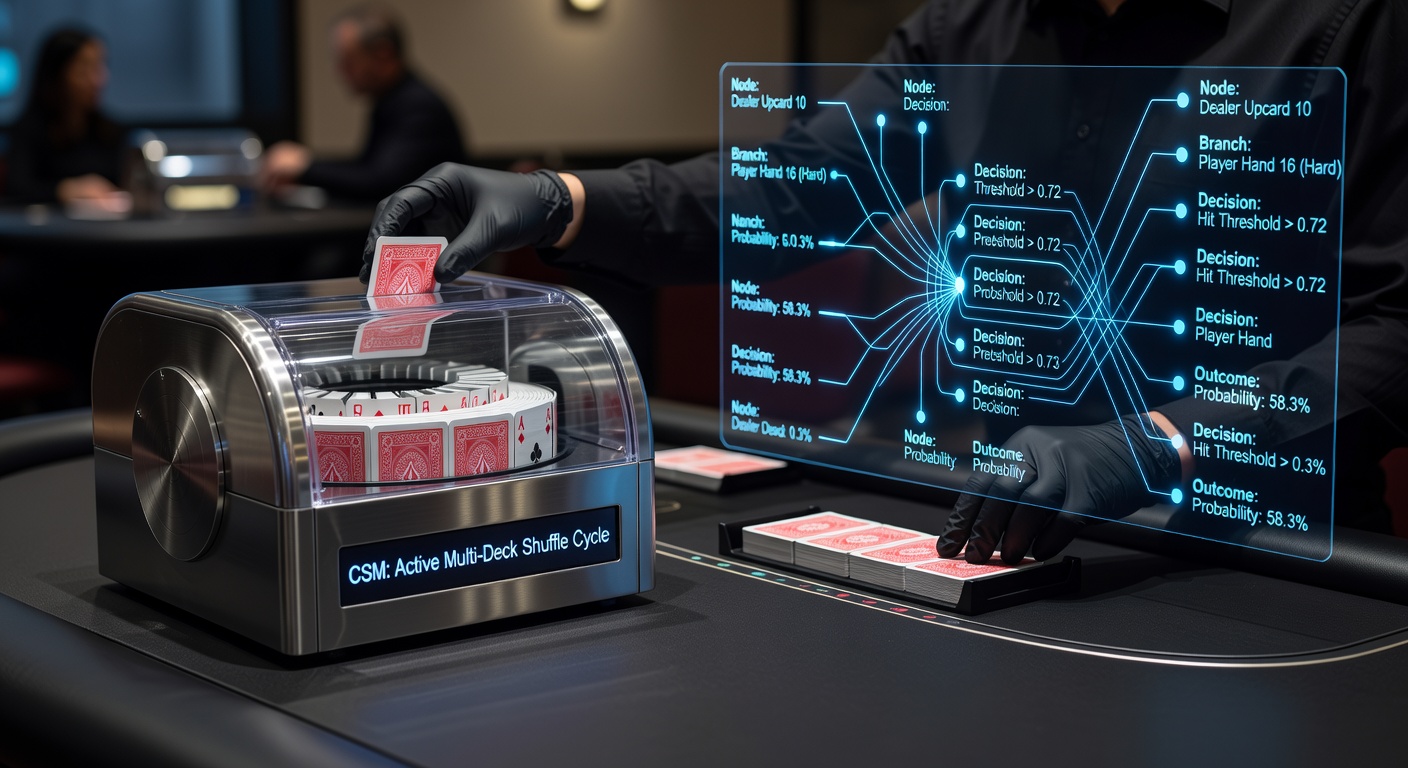
Continuous shuffling machines have become a standard feature in many multi-deck blackjack games, and they alter how adaptive decision trees function during play. These machines hold a large portion of the deck and return discarded cards to the shuffle cycle at regular intervals, which keeps the remaining shoe closer to a random state throughout each round.
Adaptive decision trees represent systematic approaches that adjust basic strategy recommendations based on the current composition of the remaining cards. In multi-deck settings without continuous shuffling, players and analysts track card flow to modify hit, stand, double, and split choices as certain ranks deplete faster than others. When a continuous shuffling machine operates, however, the feedback loop between observed discards and future expectations shortens dramatically because fresh cards re-enter the active deck almost immediately.
How Continuous Shuffling Machines Operate in Practice
Modern continuous shuffling machines typically process between four and eight decks at once, and they cycle through the discard tray at intervals ranging from every one to three rounds depending on the model and casino settings. The mechanism feeds cards back into the main stack via an internal conveyor, which randomizes order without stopping the game. This design maintains game pace while limiting the depth of penetration that card trackers can exploit. Data from casino equipment suppliers indicate that continuous shuffling machines now appear in roughly 40 percent of multi-deck blackjack tables in major North American jurisdictions as of early 2026.
Adaptive Decision Trees and Their Core Mechanics
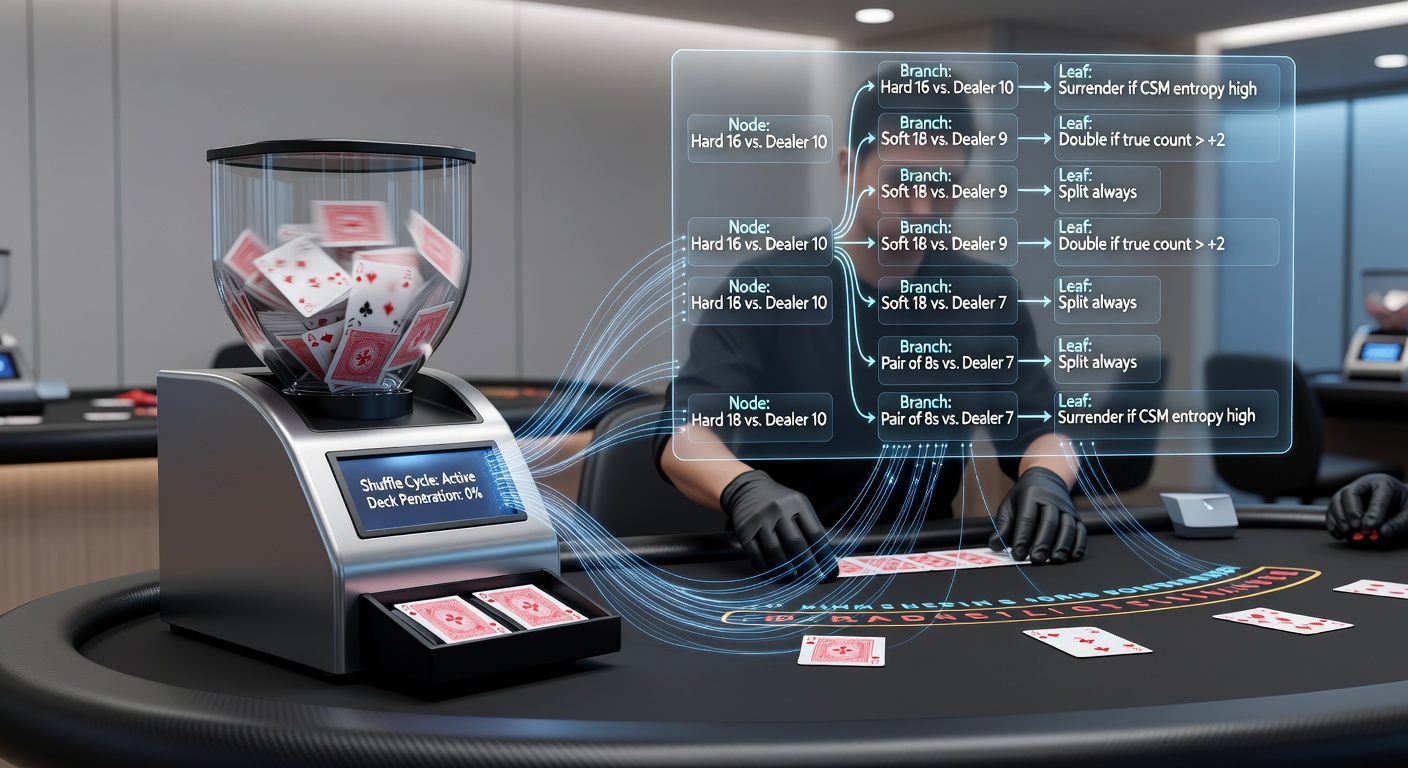
Decision trees for blackjack start with the fixed basic strategy matrix and then layer conditional branches that respond to running counts or more detailed composition data. Researchers at institutions such as the UNLV Center for Gaming Research have documented how these trees expand when penetration reaches 75 percent or more of the shoe. Each additional tracked variable, such as the ratio of tens remaining or the exact count of aces left, adds a new node that refines expected value calculations for the current hand. The trees become most valuable when the deck state deviates significantly from the initial random distribution, a condition that continuous shuffling machines actively suppress.
Direct Effects on Tree Accuracy in Multi-Deck Play
Once a continuous shuffling machine activates, the correlation between observed discards and upcoming cards drops sharply. Studies published by the Canadian Gaming Association show that the effective counting window shrinks from perhaps 60 to 80 cards deep in a traditional shoe to fewer than 20 cards when continuous shuffling runs at standard speeds. As a result, the branching points in adaptive decision trees receive less reliable input data, and the magnitude of edge adjustments shrinks accordingly. In practice, players who rely on these trees observe smaller swings in recommended actions across consecutive hands because the machine continually resets the distribution closer to its starting probabilities.
Multi-deck environments already dilute counting signals compared with single-deck games, and the addition of continuous shuffling compounds that dilution. Operators report that table minimums and maximums remain stable even as these machines run, because the house advantage stays within predictable bounds without requiring frequent rule changes. In May 2026 several regional gaming authorities reviewed equipment approval standards for newer continuous shuffling models that offer variable shuffle intervals, yet the core mathematical relationship between machine cycle time and tree precision stayed consistent with earlier findings.
Operational Considerations for Casinos and Analysts
Casino surveillance teams monitor both the mechanical performance of continuous shuffling machines and any attempts to map remaining deck composition through electronic or manual means. Because the machines operate continuously, analysts who build decision trees must incorporate shorter observation windows and higher variance estimates into their models. Training materials distributed by equipment manufacturers emphasize that recalibration of tree thresholds occurs more frequently when shuffle intervals change, which prevents over-adjustment based on stale information.
Equipment audits conducted across multiple jurisdictions confirm that continuous shuffling machines reduce the occurrence of extreme deck compositions that would otherwise trigger large deviations in adaptive strategy. This reduction translates into steadier theoretical hold percentages for operators while still allowing standard basic strategy to function without modification. Those who study the interaction note that tree complexity can be scaled back in continuous-shuffle settings without sacrificing measurable accuracy, since fewer nodes reach statistical significance.
Conclusion
The relationship between continuous shuffling machines and adaptive blackjack decision trees in multi-deck environments centers on the compression of usable information about card distribution. Machines maintain a near-random state by returning discards quickly, while decision trees lose precision when their input data no longer reflects future cards with sufficient reliability. Current equipment standards and research summaries indicate that this interplay continues to shape table configurations and analytical approaches without requiring major regulatory shifts beyond routine equipment testing. Observers tracking developments through 2026 continue to monitor how incremental changes in machine cycle timing affect the practical value of refined strategy models.